
Biscotti for My Substackaversary
Four generations; three hundred subscribers; two years publishing; one recipe

There’s now more than 300 of you subscribing to Words & Water as it crests its second year on Substack. Welcome! For the occasion, let me (re-)introduce myself to all of you. I was raised in San Francisco magazine and newspaper offices and bars, studied to be a marine biologist but then fell into journalism and it was love at first byline. I worked as a freelance journalist in Rome from 1987 to 1992 where I learned the craft at the Associated Press and then Newsweek, plus a stint at Vatican Radio’s English language program. My mom’s family came from Tuscany, in the hills above Lucca, and Italy has always felt like my second home as if part of my bisnonna (great-grandmother) Pia was finally able to return to the homeland she left in 1913 and never saw again. Back stateside, I was the managing editor of the Argonaut with my father Warren Hinckle until he fired me for trying to make him keep a deadline. Our complex relationship with each other, writing, drinking, & Catholicism is the backbone of my forthcoming memoir The Muckraker’s Daughter: A Memoir of Love, Death & Deadlines (repped by Pete Mulvihill at The Watermark Agency and on submission). I landed at the San Francisco Bay Guardian alternative weekly where I met my husband (still!) Chris Mittelstaedt. After a Knight-Bagehot Fellowship at Columbia Journalism School, I was Business Editor at the old Hearst San Francisco Examiner before returning to freelance work while raising our three kids and helping run our family business The FruitGuys. I’m mother of a son and twin daughters who have evolved beautifully with various neurodiversities and health challenges; and a great-granddaughter, granddaughter, and daughter of Alzheimers’ women. Family and place are important themes in my writing, the river of trauma flowing between generations, the ways mistakes are repeated or rectified, and the soul of families and lives that inhabit spaces and objects. I am tied to the ocean, especially the Pacific, which nearly drowned me with a sleeper wave when I was five years old. Ever since, my fear and attraction of her has shaped my life. I began competitive open water swimming in my late 40s and it has been my greatest teacher in my writing, educating me about humility, perseverance, courage, faith, and wonder. My posts are free for now, but feel free to pledge to support my writing. More important is to give a heart or share any of my posts that resonate with you. Feel free to ask me questions. Thank you so much for being here and I wish you all a healthy and peaceful new year. This post is a revised version of my first-ever Substack post—family recipe included! Buon anno nuovo!
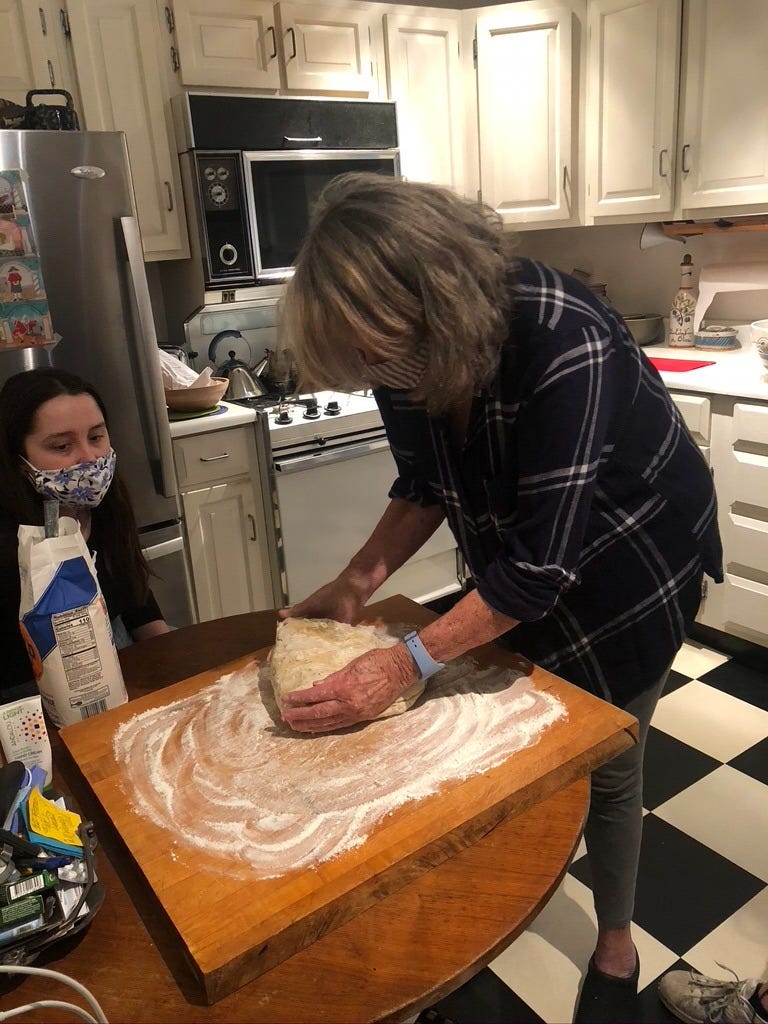
We have baked Nonni’s biscotti around Christmas for as long as I can remember. My little fingers would play in the flour Nonni (my Italian great-grandmother Pia) dusted on the wooden bread board she had pulled out of her tile counter and laid on the kitchen table. Her thin, strong fingers rolled the tan dough, almost white against her black housedress, and then shaped them into loaves to be toasted in the oven and then sliced and toasted again, once on each side. Denise, my mom, and Dee, my grandmother, all giving their opinions on how long to cook them as the gentle almond extract perfume wafted from the oven. My mouth watered at the thought of my first bite of a warm and crispy walnut biscotto.
These biscotti are perfect for dipping in coffee, tea, or a glass of red wine. Biscotti are twice-baked biscuits, cookies but not too sweet, that originated in Tuscany, in the town of Prato, to be exact. Pia was from Convalle, a tiny hilltop village outside of Lucca, about 60 miles west of Prato.
Pia had never been on a ship, or even outside of Tuscany, when she left Genoa headed to New York in May of 1913. My great-grandfather Giocondo had come back to get her after being gone to l’America for four years, part of which he worked rebuilding San Francisco’s streets after the 1906 earthquake. Neither of them could read or write very well, so I often wondered why she waited for him or if she thought about refusing him when he returned to the village for her. They married in February 1913 and by the time they were crossing the Atlantic, seasickness and morning sickness combined for a rotten trip for her.
“Lui sapeva, lui sapeva! E non m’ha detto niente,” she would say shaking her head that her young husband hadn’t told her why she was so sick. They immigrated through Ellis Island and then took the train to Reno to stay a stretch with Gio’s cousin Bino who was working as a sheep herder and then finally arrived in San Francisco. On January 4, 1914, Pia gave birth to my grandmother in their dark flat on Gerke Alley in North Beach.
I most remember Pia’s regal posture, her black mourning clothes, and how she covered her mouth when she smiled to hide the tooth that was missing in her right upper jaw. She had strong, long fingers that I watched make pasta out of a mountain of flour and egg yolks on the wooden table in her kitchen. She could kill a chicken with a single jerk of its neck. When she chopped off its head with a small ax on a little block of wood in the yard in Cotati, it ran around in circles with blood spurting out of its neck before collapsing.
“Guarda! Guarda!” Pia said to me. I knew what she meant even if I didn’t “know” Italian. She taught me how to pluck the feathers from chickens, ducks, and pigeons. When her Alzheimers got too severe and she left the trailer where she lived in my grandparents’ field, we would visit her in the nursing home. She didn’t know me or my mom or her daughter. My grandmother would cry quietly on the way home. Once, she broke the neck of the parakeet of a nursing home neighbor and plucked it, telling everyone in Italian that she was going to make polenta and pigeon stew.
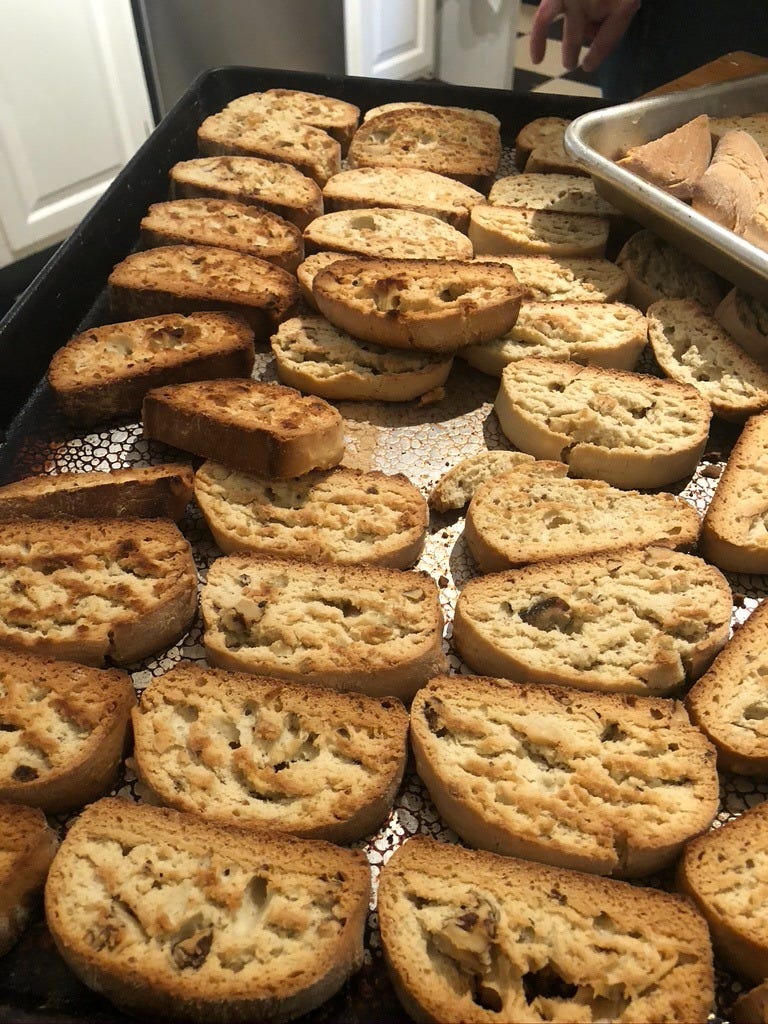
Cooking these biscotti is a slow-food experience. The dough needs to rest for at least 4 hours (or overnight) before being cut into loaves, baked, then removed, sliced into biscotti and then baked on each side.
Nonni’s Biscotti
Makes about six dozen biscotti. Will keep in an airtight container for up to 2 weeks though I confess I have eaten these many months later and while they are hard, they are still delicious for dipping.
(Note: This recipe can be halved to make a smaller batch, but why not share them with your friends?)
EQUIPMENT
Extra large mixing bowl
Two baking sheets
INGREDIENTS
Ten eggs
2½ cups sugar
6 cups flour, plus for dusting
Six teaspoons double-acting baking powder
One stick (8 tablespoons) of melted butter (cooled)
Two tablespoons Crisco (melted) or olive oil
One teaspoon vanilla extract
One teaspoon almond extract
4 ounces whiskey
1½ cups walnuts, coarsely chopped
PREPARING THE DOUGH
Using an extra large mixing bowl, whisk the eggs together with the sugar, melted butter, Crisco/oil, vanilla & almond extracts, and whiskey.
Add the nuts and mix well with a large wooden spoon.
In another bowl, combine the flour and baking powder.
Add dry ingredients lowly to the egg mixture, folding until absorbed, then add more.
Cover the bowl and refrigerate for a minimum of 4 hours—or overnight. The dough will rise some.
BAKING
Preheat oven to 350°F.
Prepare a floured surface.
Remove the dough from the bowl and knead the dough, sprinkling flour until it is no longer tacky.
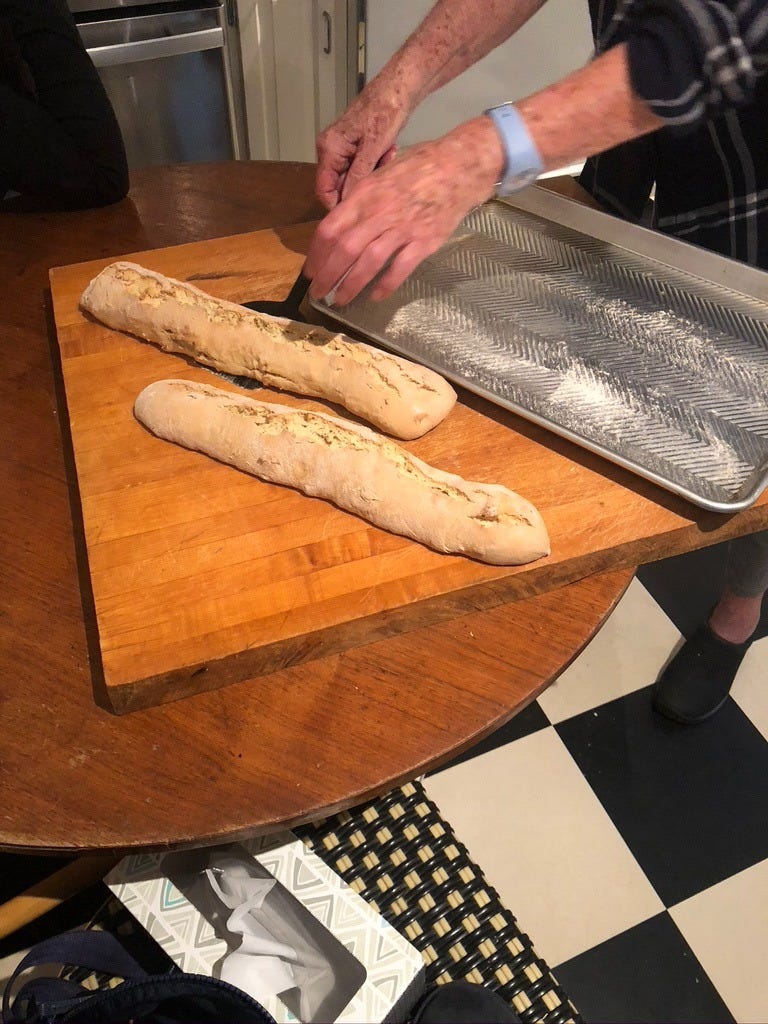
Divide the dough into five equal-sized loaves.
Grease the baking sheets with butter (or use parchment paper) and place 2-3 loaves on each one.
Bake until loaves begin to brown on the bottom and a toothpick comes out clean, about 10-15 minutes. Pay attention that they do not burn.
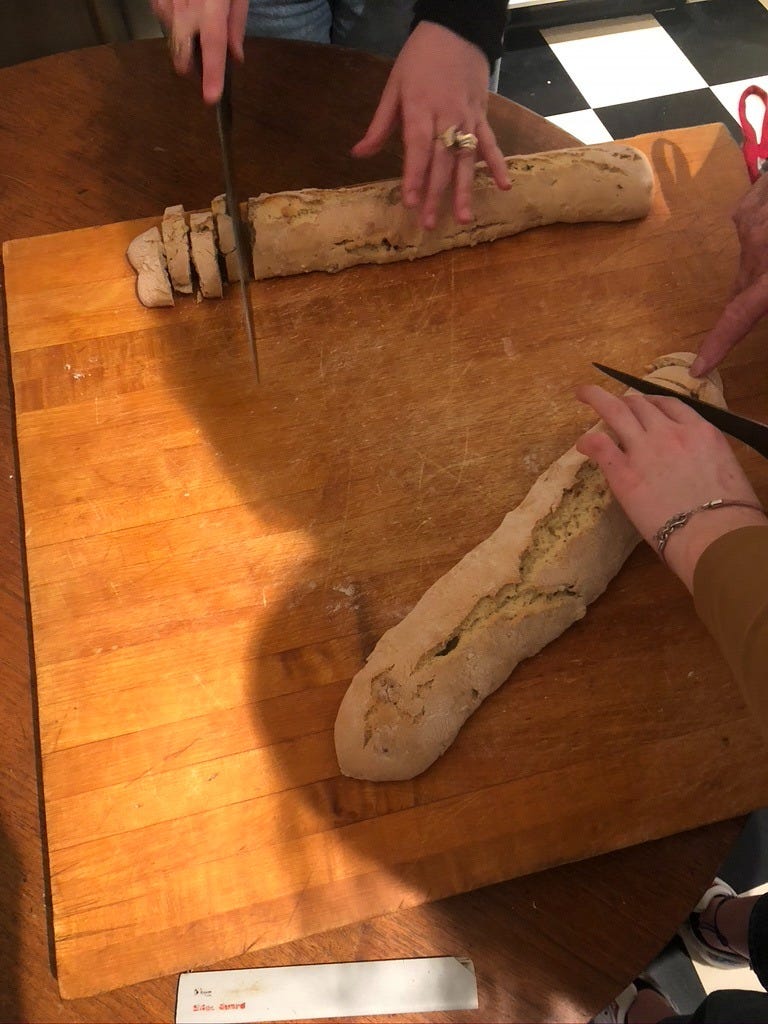
Remove loaves and slice like a loaf of bread into 1-inch pieces.
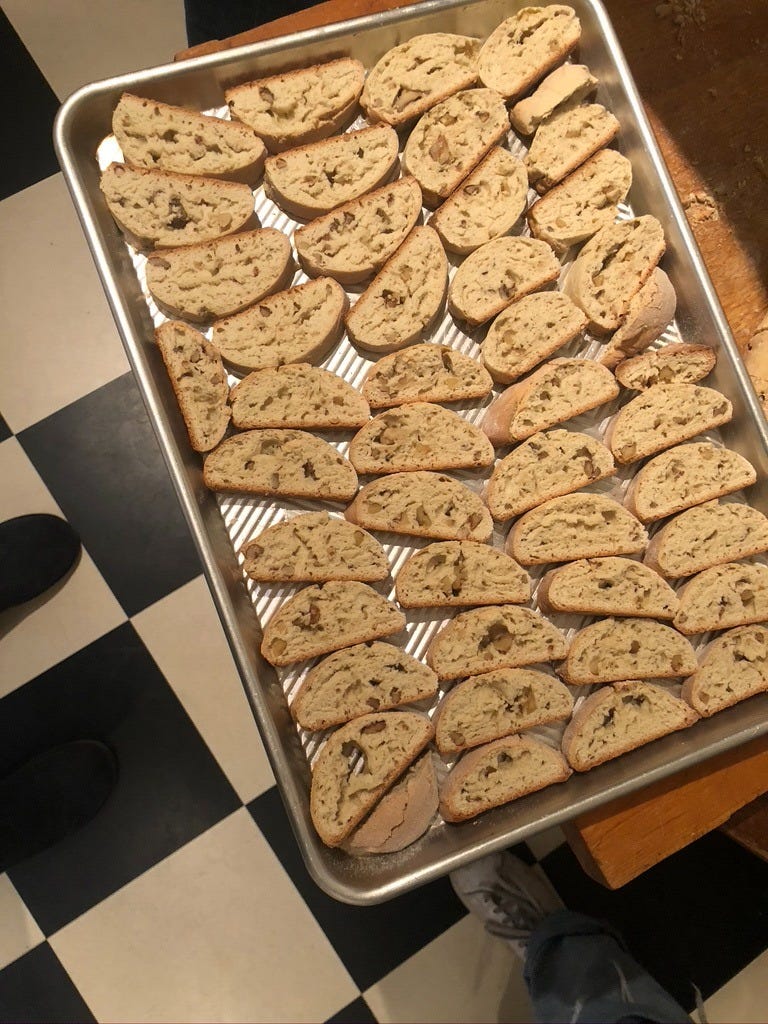
Lay the slices flat on a baking sheet and put back into the oven. Bake until the bottom of the slices begin to brown, about 10-15 minutes.
Remove and turn slices over and bake the other side until brown, about 10-15 minutes.
Serves 10. Cook time, 45 minutes. Store in a container for up to two weeks.
Just catching up with everything you've written since October! Sorry, I've been abroad . . . (swam in the Bondi Icebergs pool!). I will try making these biscotti this weekend . . . I'm on a big sourdough focaccia-making journey lately. Maybe I can make some sourdough biscotti at some point . . . worth a try.
I am so looking forward to reading your memoir and making Nonni’s Bisconti!