
Going Polar
Turning 60 pushed me to swim longer and colder than I ever have before

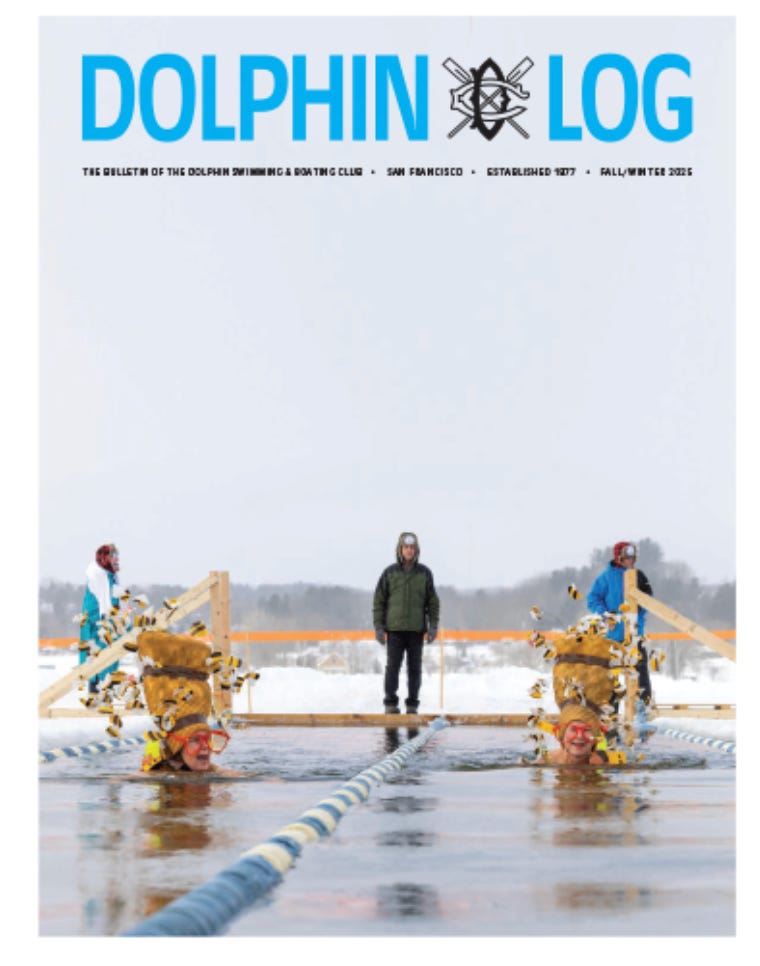
I am thrilled this tale was the cover story for the 2025 Winter issue of the Dolphin Log, the magazine of San Francisco’s Dolphin Swimming & Boating Club, established in 1877, where I’m a lifetime member. The club’s annual Polar Bear Swim challenge is to swim 40 miles in water below 57 degrees between December 21 and March 21. I was interviewed on the club’s podcast 2000 Stories in 2024 about my journey in the water from panic to pleasure and how it has informed my writing practice and my memoir, The Muckraker’s Daughter (still on submission!).
I open my eyes in the dark and check my clock: 4:40 a.m., exactly five minutes before my alarm was set to go off to get ready for my 6 a.m. swim. I am always amazed that my body automatically wakes so insanely early after I spent my whole BS (Before Swimming) life sleeping as late as I could.
It’s early February 2025 and I have been 60 years old for about a month, but since December 21 I have been swimming up to six times a week and sometimes, like today, six times a day — all in the absurd pursuit of my goal: to swim my age for this year’s Polar Bear Challenge.
You may be reading this as a seasoned bear who has swum many more miles than that, or maybe you think you are too slow, too old, too scared, too (fill in the blank). Well, I’m here to tell you that no matter where you are starting from, even zero winter swimming: If I could do it, so can you.
If you had told me 10 years ago that I would be swimming before dawn in San Francisco Bay without even a neoprene cap, and swimming 60 miles in the three months between December 21 and March 21, I woulda said you were crazy. Guess I’m the crazy one now.
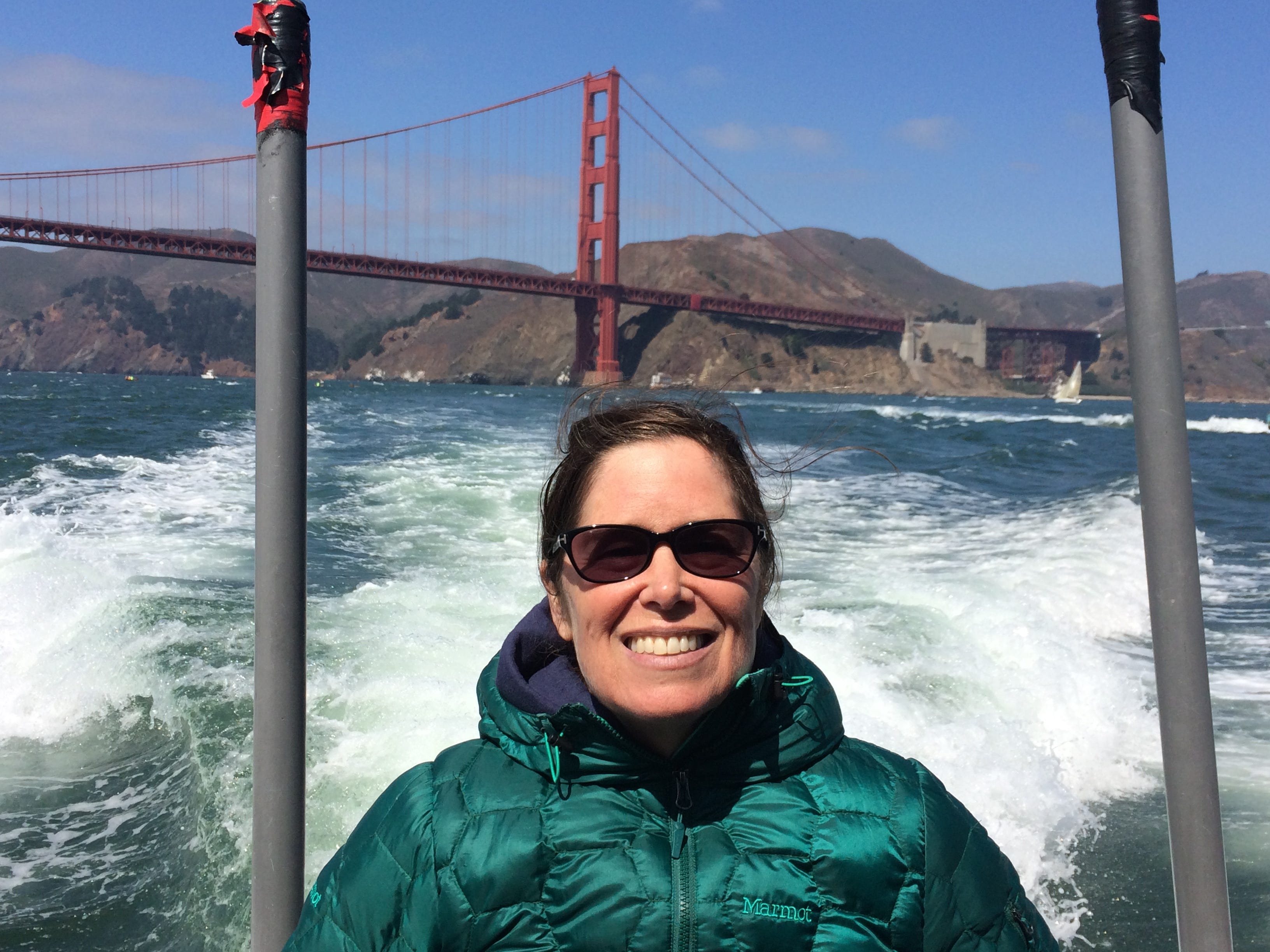
It wasn’t always so. I had been a Dolphin Club member for 20 years before I got the courage and confidence to try my first out-of-cove swim. I hadn’t swum in high school or college. I didn’t consider myself a “strong” swimmer. I mostly sidestroked. And I had recurrent panic attacks triggered by the cold water that terrified and depressed me. I longed to be comfortable swimming in the bay I loved so much. I kept at it, and little by little, swim by swim, supported by a coach and Dolphin friends, I completed the 2014 Gas House Cove 1-mile swim at age 49. Even then, my fears persisted, but I kept swimming. That year I made my lifelong dream to swim Alcatraz and the Golden Gate. And I kept swimming.
And still, reaching the 40-mile mark to qualify as a Polar Bear seemed out of reach. My usual swim was just a half mile — at that rate, how could I ever get enough squares on the big board? I was sure I didn’t have the time. It wasn’t until the winter of 2019 that I completed my first Polar Bear (42.5 miles!) and started to learn the secret to getting it done: planning.
How to Plan a Polar Bear
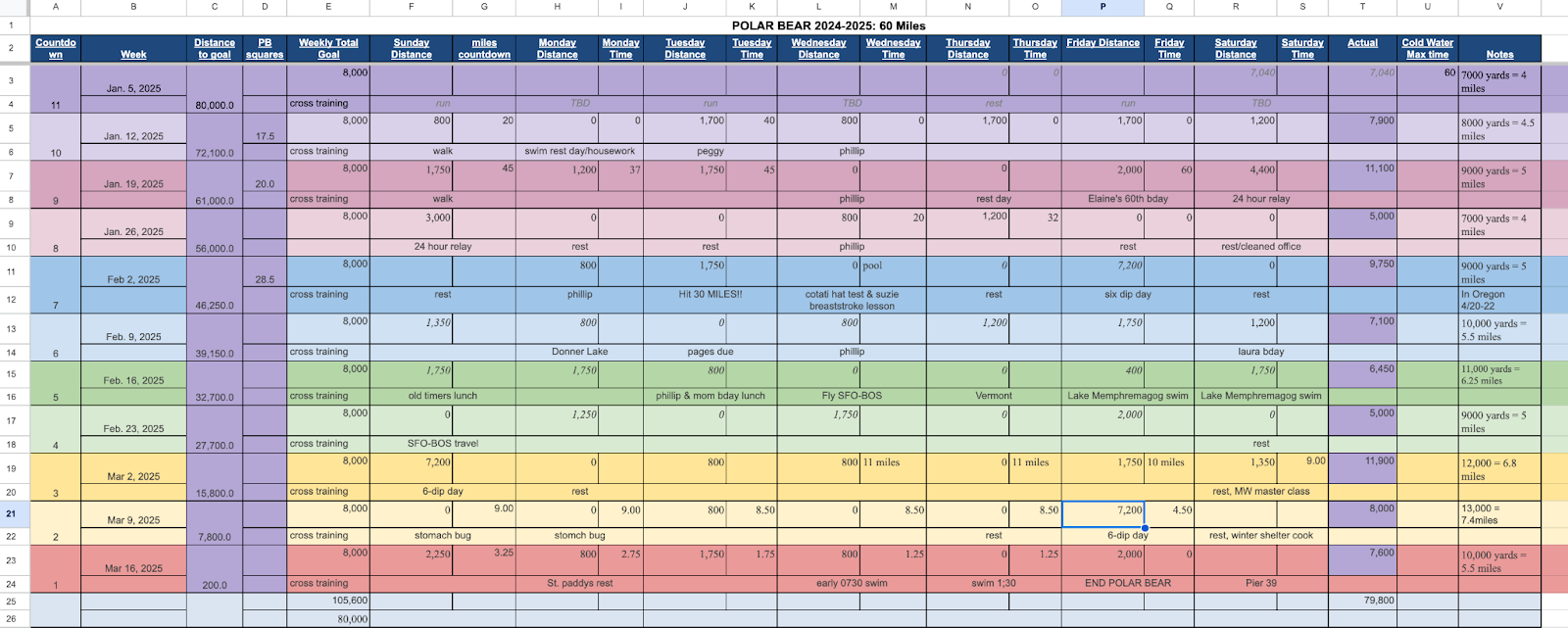
That fall, I mapped out the 90 days of Polar Bear, almost 13 weeks, on a physical calendar, noting holidays and travel when I couldn’t swim. To get to 40 miles, I needed to swim at least three miles a week, which for me might be six half-mile swims or three 1-mile swims or four three-quarter-mile swims, or a mix of the three. Each week, I booked time for my swims.
In a notebook, I drew my own version of squares, divided week by week, so I could track my progress. Each week, I adjusted the following week’s swim plan, depending on how much I needed to catch up. I made swimming four-five times a week a priority, stealing the hours from work and family. When illness or travel interfered, I made up for it with longer swims, more swims, and my first experiments with double dips (a regular 20-30 minute swim, sauna warmup and snack, followed by a 10-15 minute swim). I laid it all out on a spreadsheet.
Determination can get you to a Polar Bear, but to make it fun, you need friends. Luckily, the club is a great source of approachable, inspiring lunatics. My go-to lunatic was Elaine Van Vleck, who turned 60 the same month as me. Together, we set our winter swim goals for 2025: 60 Polar Bear miles, including six 6-dip days, and six 60-minute swims. In addition, we would return to the Lake Memphremagog Winter Swimming Festival in Vermont with our eyes set on winning their most competitive event—the hat competition.
Swimming a Six-Dip Day
When Elaine and I set 60 miles as our goal, I was intimidated. I honestly didn’t see how I could do almost 20 more miles than my previous four Polar Bears. What better way to rack up the miles than swimming six times in a day, Elaine suggested. And why not do that six times to honor our 60th year, I countered. Encouragement from a friend, your pod, or someone in the sauna may be what helps you go beyond what you think you can do. That’s what has worked for me.
Elaine is a genius at breaking down a complex swim into manageable bites. Her plan: toes in at 6 a.m., swim for 30-60 minutes, then warm up and snack, and back in again at 8 a.m. Repeat at 10 a.m., noon, 2 p.m., and take a final dip at 4 p.m. Having swum Suzie Dods’ 24-Hr Swim Relay the last few years (a great introduction to night swimming and multi-dips), I understood how it was possible to swim multiple times and not get hypothermic—as long as you had enough snacks, warm drinks, dry bathing suits, and time to warm up.
We would arrive at 5:45 a.m., when the club was silent and empty besides a couple of the regular pre-dawn swimmers. Then the rush and babble of mid-morning and noon swimmers before the quieting in the afternoon as the light faded from the sauna’s windows. The bay was dark and mostly calm before sunrise as we swam energetically with our blinking lights clipped to our goggle straps; the wind would come up and slap us around in the afternoon when we were tired. Admittedly, swims 5 and 6 trended shorter than the ones earlier in the day. We invited anyone to join us, and some did, mostly enjoying a double or maybe a triple dip.
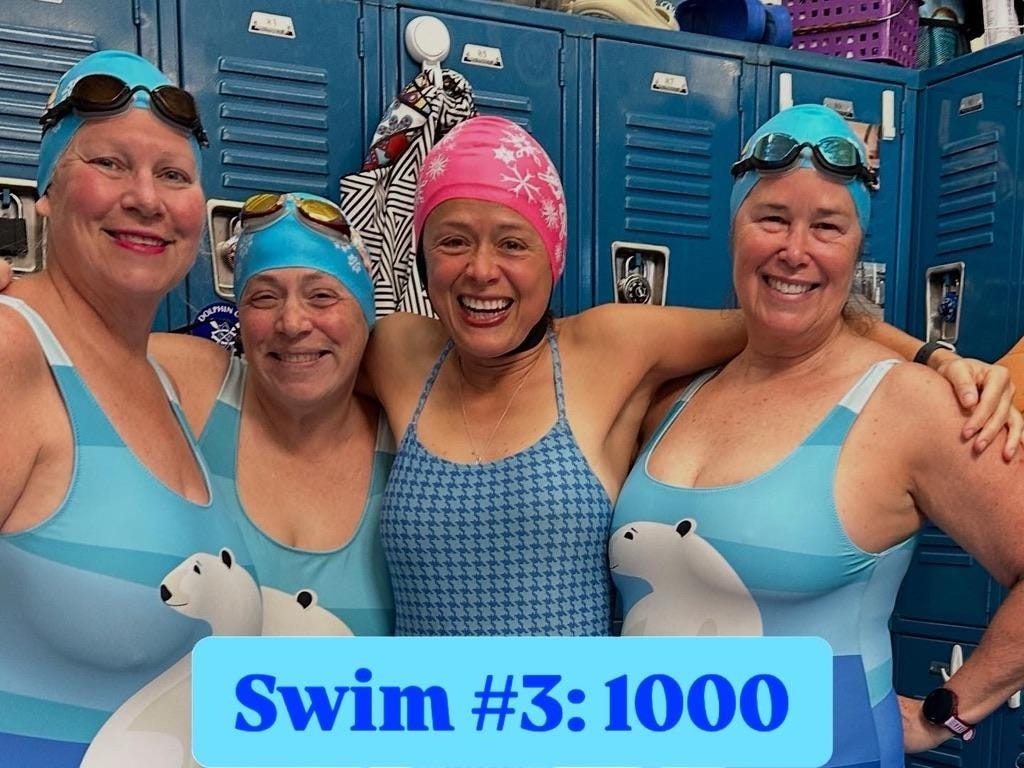
Of course, swim fashion1 was critical to morale and our success. Crissa Williams joined us for most of our dips, and the three of us coordinated our bathing suits and caps to match for different swim times: Garibaldis (by Hardcoresport) at 6; polar bear suits at 8, Deakin & Blue blue suits at 10; etc.. The deck of the Dolphin Club became our aquatic catwalk.
We got our technique down: swim, shower, dry off, and drink something warm in the sauna. Put on a dry bathing suit before leaving the sauna and then bundle up in layers. We would huddle around the heater in the Staib Room to eat snacks and chat until it was time to plunge in again.
From Polar Bear to Ice Swimming
Now that you’ve swum a Polar Bear, as I first did in 2019, you might get curious, as I did, if you could do an ice swim. That’s how, in 20242, I found myself, along with Elaine and Suzie Dods, in Newport, Vermont, at the Lake Memphremagog Winter Swimming Festival. The water in the two-lane, 25-meter pool cut into the ice of the frozen lake was 31 degrees F/ -0.5 C. TOTALLY COLD, as they advertised.
To prepare, I had weaned myself off of my neoprene cap (not allowed in this event), which I had used since I first joined the club. It was easier than I thought—once I realized it didn’t keep me that much warmer than a single latex cap. To prepare for Vermont, my favorite swim roadie (my husband Chris Mittelstaedt) drove us to Donner Lake in the Sierras, and Elaine and Suzie and I did a double dip in the 30-something degree lake. I had experienced the effect that kind of cold has on the hands when I had swum at Brighton Beach, New York, in the winter of 2022: it burned.
I find the cold of ice swimming to be the opposite of the cold of our winter bay swimming. In Aquatic Park, I feel the cold build from the inside out. If I am hydrated and well-fueled, I can keep swimming long after my hands become stiff claws.
But for me, the cold of ice swimming moves from the outside in. The skin burns. The brain and nervous system go into slo-mo mode, and you must impel your limbs to keep swimming. I haven’t yet ice swum long for enough minutes to have the fire-cold seep deep into my core. Maybe you die before that?
I’ve learned that with the time I have left in this body that is reasonably cooperative with unreasonable demands, I don’t want to be comfortable.
Water at 30.5 degrees F/ -0.5 C bites you on contact like a wild animal searching for a warm place to hide. That’s what it was in February 2025 when we won the 25-meter breaststroke Hat Competition swim. We went with a beehive theme because, well, we Bee 60!
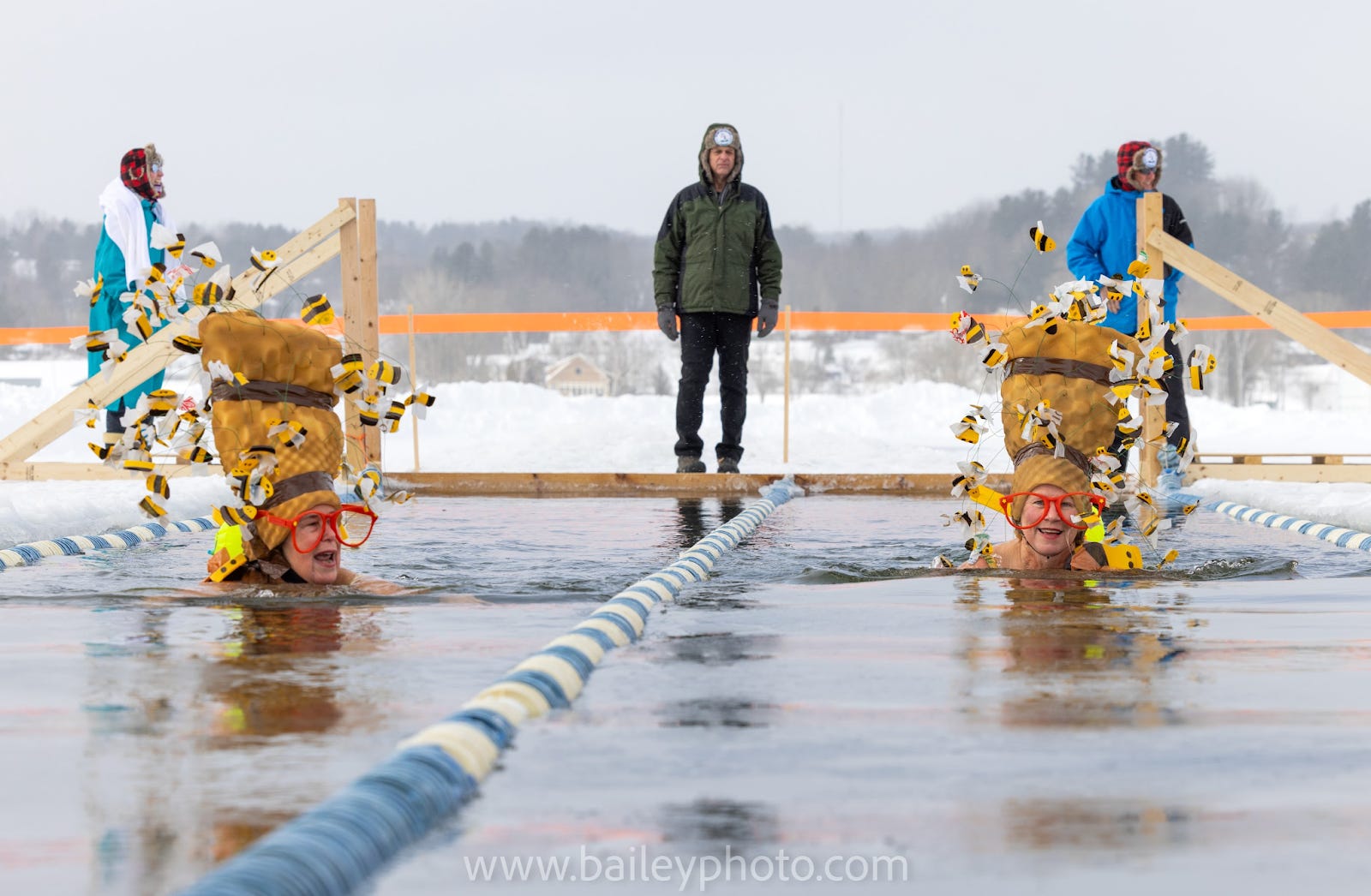
One hundred-twenty yellow plastic bees swayed in the biting Vermont wind at the end of green gardening wires that were sticking out of our towering kebab-like foam beehives that was duck-taped to our swim caps. I took off my deck coat and stood next to the 25-meter pool cut into the ice of Lake Memphremagog in my bee bathing suit and yellow tutu and looked across at Elaine stepping down the wooden ladder into the water with her matching outfit. I mirrored her movements until we were both standing on the submerged platform. My legs immediately were numbed up to my thighs.
Beehives held high, we breaststroked in tandem through the viciously cold water. My hands were on fire as I watched ice floes forming on the surface of the water ahead of me. I exhaled purposefully to calm my heart rate and respiration. Swimming in icy water, even just the 30 seconds or so it will take me to get across, requires training and acclimation, but it is also a mental game: can I stand the burning? Can I keep breathing? Can I keep my body moving when my brain freezes to a halt?
“It’s like swimming in a freshly shaken martini!” I yelled to the onlookers as Elaine and I smiled in our matching red lipstick and red cat eye glasses with 120 bees waving around our heads.
Cameras clicked. (A photo of us was featured in the Washington Post!) We made it to the other side. Escorts wrapped us up, put on our ice-cleated Crocs, and walked us to the warming room (no shower or sauna). Suzie had it organized, and I found a chair with a warm footbath waiting; a volunteer put a microwaved tube sock of rice around my neck. Some swimmers were shivering, but my only discomfort was the painful defrosting of my hands. That passed after about 10 minutes, and I felt fine. Maybe I could do more?
Later that day, I changed my 25-meter freestyle to a 50-meter freestyle. Putting my face in the water was more challenging than the behatted breastroke had been, and I struggled to get a proper rhythm to my stroke. After the turn, I found my brain slowing down, and I wondered if I was still swimming. Then I made it to the other side and was done. Time in the icy water: 1:03:86.
With my epic season of winter swimming behind me, I’ve had a chance to think about the reason I was so driven to make it happen.
I never imagined I would become a later-in-life athlete, much less an ice swimmer. Fellow swimmers and non-swimming folk alike have often asked me why I do it. Why swim when it’s so cold? Why not sleep in? Isn’t all this swimming a little obsessive? The short answer is: because I still can.
This age has brought the distinct realization that I am in the Thursday of my life and I can see the weekend on the horizon. Sunday is the end. I’ve learned that with the time I have left in this body that is reasonably cooperative with unreasonable demands, I don’t want to be comfortable. I want to be challenged physically and mentally, and I find satisfaction and joy in doing hard things like writing a memoir, doing six-dip days, and ice swimming. Time is awasting. Write now, swim now, or forever hold my peace.
Curious how many bathing suits I have? Read Our Bodies, Our Bathing Suits
How was my first time ice swimming? Read On the Rocks, What Ice Swimming Taught me at 59
Stroke On, Pia!
My favorite words: "I never imagined I would become a later-in-life [insert your adventure here] .... The short answer is: because I still can."
Pia, I got cold just reading about your ice swimming. You're a rare and remarkable woman, living according to Eleanor Rooseveldt's commandment: "You must do what you think you cannot do." I admire and love you dearly for it.